In this study, a liquid gel bandage for wound treatment was synthesized using a combination of tannic acid and polyethylene glycol (TAPE). Agar was added as a stabilizer based on the physical properties of the formed product. Ethanol was chosen as solvent based on the resulting drying rate and mixing consistency. The liquid bandage was characterized in terms of its drying, adhesion, and swelling. Also, its antimicrobial and cytotoxic properties were evaluated. The final formulation had a drying time of 5 minutes, a T-peel adhesion yield point of 591.6 Pa, and a swelling ratio of 64%. The gel was also observed to be anti-microbial towards both S. aureus and E. coli, as well as exhibiting cytotoxic effects. Overall, the gel proved to have comparable properties to previously studied liquid bandages yet can be produced at a significantly lower cost.
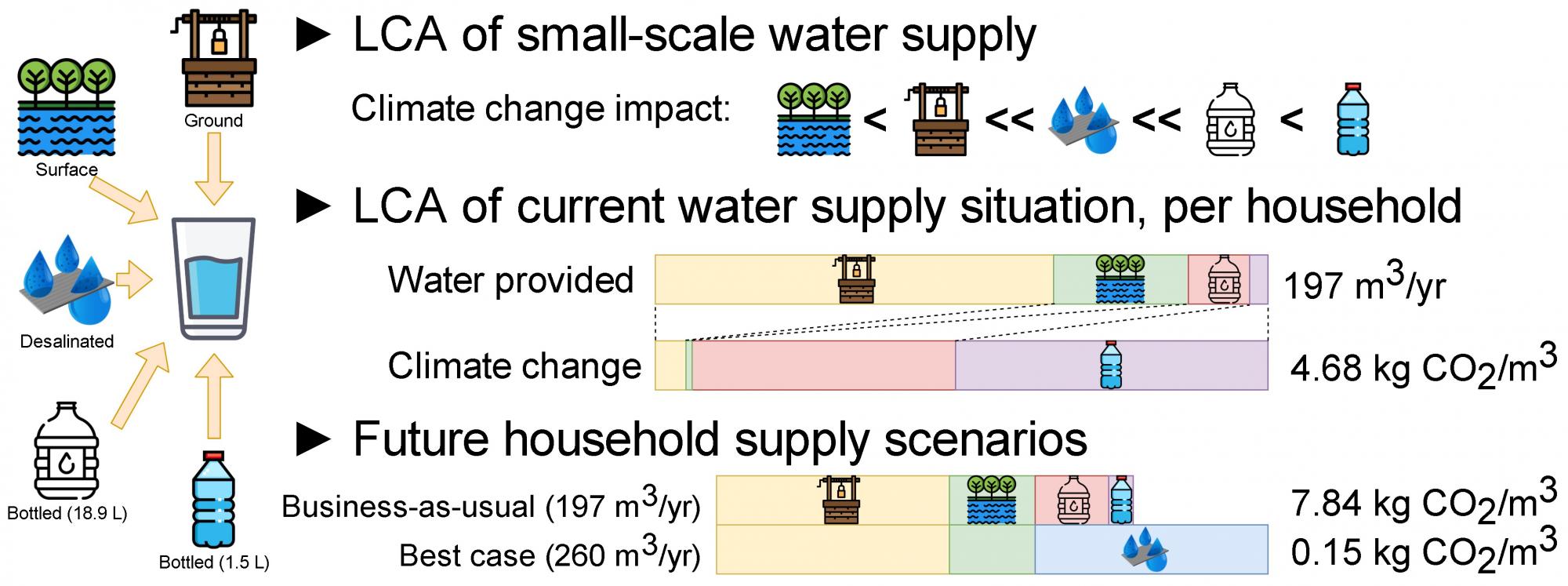
Access to clean water is one of the targets in the UN Sustainable Development Goals. However, millions of people are still without basic water services, predominantly in rural areas in developing nations. Previous studies have investigated the environmental impacts of water provision, but they mostly focused on large-scale urban systems. This paper considers for the first time the life cycle environmental impacts of different water supply options applicable to remote communities in developing countries. Focusing on the Southeast Asia-Pacific (SEAP) context, a cradle-to-grave approach is followed to estimate the impacts of locally-sourced groundwater, surface water and desalinated seawater as well as externally-sourced bottled water. The results reveal that surface water is environmentally the most sustainable alternative. Locally desalinated water, powered by diesel electricity, has two orders of magnitude higher impacts than surface water. However, externally-sourced water in plastic bottles is the worst option with 4–155 times higher impacts than desalinated water and up to three orders of magnitude higher impacts than surface water. This is largely due to the impacts related to the production of bottles. Doubling their recycling would reduce the impacts by 7–23% but bottled water would still be environmentally the least sustainable option. Although water in single-use bottles currently provides only 3% of the water supply of a representative remote community in the SEAP region considered in this study, it accounts on average for more than 50% of the total impacts from water consumption. By 2030, population increase could lead to greater reliance of remote communities on bottled water and 60–73% higher impacts of water consumption per household. Relying solely on local surface, ground and water desalinated using solar power and avoiding bottled water would reduce the impacts by 33–99% relative to the current situation. This would also improve considerably water availability and security in remote communities. The findings of this study will be of interest to national and local governments developing future policies aimed at increasing access of remote communities to clean water.
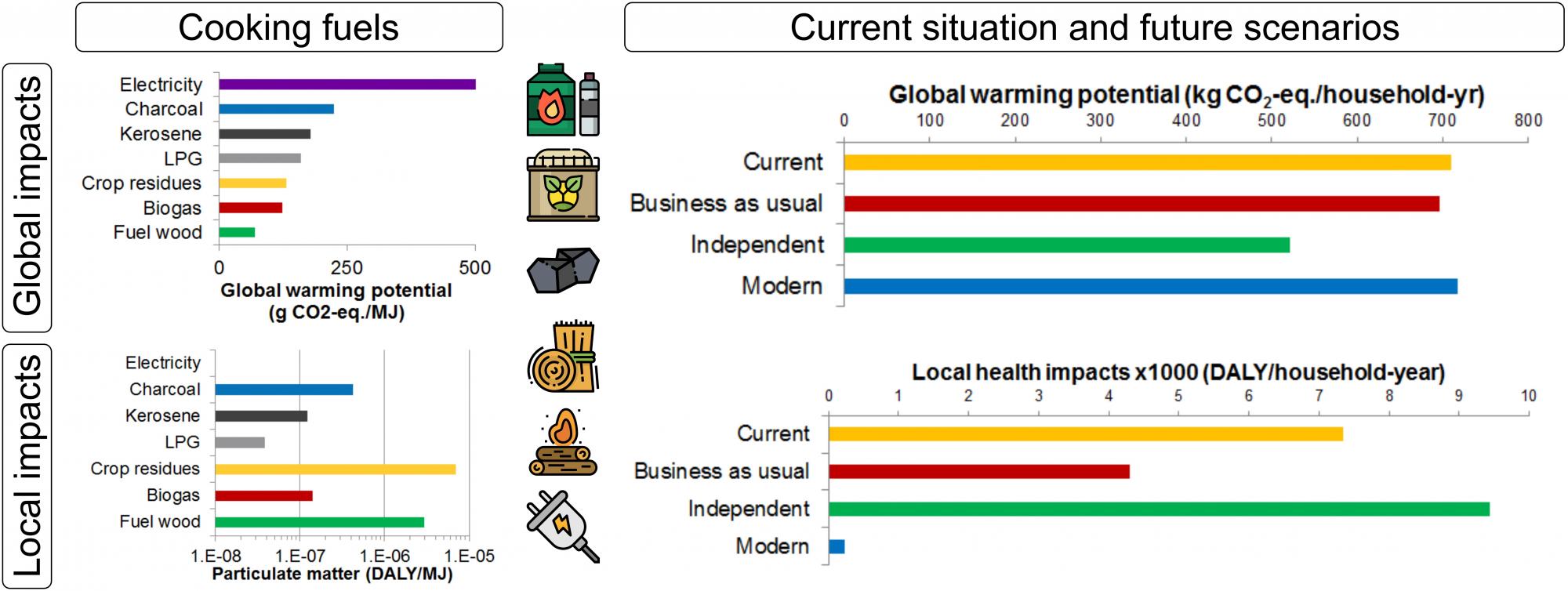
Access to clean cooking fuels and technologies is essential for achieving the Sustainable Development Goals, particularly in developing countries, to minimise human health and environmental impacts. This paper assesses for the first time the environmental sustainability of household cooking, focusing on remote communities in developing countries in the Southeast Asia-Pacific (SEAP) region and considering both life cycle and local impacts. To guide rural development policies, the impacts of the following cooking fuels are considered: liquefied petroleum gas, kerosene, wood, charcoal, crop residues, biogas and electricity. Both the present situation and three future (2030) scenarios are evaluated on 18 life cycle impacts, as well as on local environmental and health impacts caused by cooking. The results show that electricity is the worst option in 13 out of 18 life cycle categories since it is generated from diesel in off-grid communities. Biogas from manure is the best fuel with 16 lowest life cycle impacts. Biomass fuels can have lower life cycle impacts than fossil fuels but they have high combustion emissions which lead to higher local environmental and health impacts. Future scenarios with higher biomass utilisation have up to 47 times lower life cycle impacts than at present, but 4–23% higher local impacts. Health impacts related to fuel combustion are higher in Vietnam, the Philippines, Cambodia, Laos and Myanmar compared to the other SEAP countries due to regional background pollutant concentrations and health trends. A fuel mix with liquefied petroleum gas, biogas and renewable electricity offers considerable reductions in 13 life cycle impacts compared to the present situation, while also reducing local health impacts by 78–97%. A self-sufficient fuel mix with local biomass and renewable electricity would reduce 17 out of 18 life cycle impacts, but all local impacts, including on health, would be 11–28% higher than at present. The results from this study can be used by policy makers and other stakeholders to develop policies for clean cooking in remote communities and reduce both environmental and human health impacts.
Maria F. Mangahas. 2020. “The Ethnographic Collections in UP Diliman.” In Adhika: Vision & Legacy - The University of the Philippines Diliman Collection, edited by Cecilia Paz Tessa Maria Guazon de la and (eds.), Pp. 65-81. Quezon City: Office for Initiatives in Culture and the Arts (OICA), University of the Philippines, Diliman.
Considering how much protein is loaded into the process, the crosslinking solution concentration and the weight percentage of the alginate/hydroxyethyl cellulose coating material, this study presented the details of optimization of the microencapsulation process. Optimization was done with an objective of maximizing the encapsulation efficiency of the microparticle fabricated using external ionotropic gelation method. Results showed that the process is capable of achieving around 75% encapsulation efficiency when protein loading is around 15 wt%, alginate/hydroxyethyl cellulos is about 2 wt% and the CaCl2 solution should be 3 wt%. This was done using Box-Behnken methodology wherein the predicted model was found to have good predictive capability. Analysis also showed that the process is affected by how much protein drug is loaded into the system and the interactions between crosslinking solution concentration with bovine serum albumin (BSA) loading as well as the strong relationship between alginate/hydroxyethyl cellulos concentration with itself.
A methodological challenge for researchers performing content analysis on social media data involves deciding on a sampling procedure for obtaining content to be analyzed with least sampling error. The study used and recommended two different kinds of elementary unit—post and day—that allow probability sampling of Facebook data, regardless of whether the sampling frame of all posts within the time period of interest is obtainable. Four sampling designs for post as elementary unit and five for day as elementary unit—including three commonly used sampling options for content analysis: simple random sampling without replacement (SRSWOR), constructed week sampling, and consecutive day sampling—were employed on Facebook data mined from Mocha Uson Blog from 2010 to 2018. Estimates for parameters, such as measures of user engagement and proportions of topic-related posts, were obtained at increasing sample sizes. Sampling designs for each elementary unit were evaluated by comparing the normalized area under the coefficient of variation curve (NAUCV) over the different sample sizes. For post as elementary unit, with content type as the stratification variable, stratified random sampling (StRS) using Neyman allocation based on total user engagement is recommended (average NAUCV = 31.28%). For day as elementary unit, SRSWOR is recommended (average NAUCV = 42.31%).
This paper aims to contribute to the scarce literature describing the grammar of Iraya Mangyan — a language primarily spoken on the island of Mindoro — by providing a description of how focus and aspect are expressed in the language. Similar to most known Philippine languages, Iraya makes use of affixes that attach to verbs to mark focus. In terms of expressing aspect, the language uses both synthetic and analytic means, and is closely linked to the type of focus affixes that verbs may combine with. When compared to previous descriptions of the verb morphology of the language, the current data seem to indicate that a shift has been occurring in Iraya’s verb focus and aspect paradigms. Differences in the features described might be due to dialectal variations; however, they could also be indicative of attrition in the language as the number of its speakers continue to shrink. A description of the language situation in the area where fieldwork for this study was conducted is also provided.
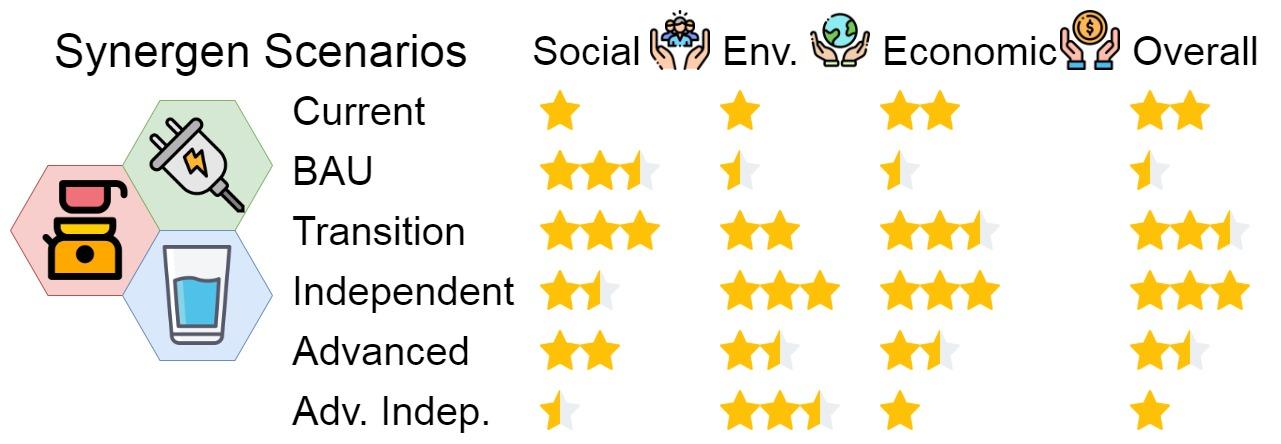
The success of deploying energy and water technologies in remote communities in developing countries can be improved by considering their synergistic relationships and their social, economic and environmental implications. This paper first evaluates social implications of current energy and water supply in a prototypical remote community against five future (2030) scenarios for synergistic provision of electricity, heat for cooking and water. This is followed by an integrated assessment of the social, environmental and economic life cycle sustainability through multicriteria decision analysis. The Business-as-usual (BAU) scenario shows high life cycle health impacts but low impacts from local air pollution. The contrary is true for the Independent and Advanced Independent scenarios which assume community self-sufficiency in energy and water supply. Greater access to electricity and water in the Advanced and Advanced Independent scenarios increases the potential for human development and security of supply, but there is an increase in the risk of accidents and decrease in social acceptability of the water supply. Similarly, a transition towards clean cooking fuels away from traditional solid biomass reduces local air pollution but increases reliance on imported fuels (BAU and Advanced scenarios). The Transition scenario is socially the most sustainable option, while Independent and Advanced Independent are the best options environmentally. They also have the lowest total operating costs, but have higher capital requirements than most other scenarios. Overall, unless extreme preferences for either environmental or social aspects are adopted, the Transition and Independent scenarios emerge as the most sustainable options. This suggests that current energy and water supply to remote communities can be transitioned sustainably to a self-sufficient system that does not depend on imported resources. The scenarios developed in this work present a framework for an integrated design and evaluation of energy and water supply in remote communities with the aim of aiding stakeholders in defining sustainable transition pathways.
The unprecedented nature of the COVID-19 pandemic has wrought a lot of changes in our lives and in our use of language. Scientific and technical terms have become part of our daily conversations. Words like coronavirus, self-quarantine, incubation period, while common to those in the medical field, were used perhaps infrequently by the general population, until recently. Tony Thorne called it the “medicalisation” of everyday language. (King’s College London, 2020). The #LexiCOVID Project was an online initiative carried out during the month of August 2020. The main goal was to look into words and concepts that Filipinos associated with the pandemic. The results of the project were then disseminated through a series of online posters on the UP Department of Linguistics Facebook page (shorturl.at/itIMR) and Instagram account (shorturl.at/yDL18). Responses to our survey featured words already in use, whether in a local or foreign language, but only recently gained usage outside their technical fields e.g., flatten(ing) the curve. Some have undergone shifts in meaning due to how they were being used in mass and social media e.g., social distancing. Some describe our new work arrangements and modes of interaction: WFH (work from home), and contactless delivery. Some neologisms in the year 2020 were also documented, e.g., Zoomustahan. All in all, what emerged from our results is a record of our lives in lockdown describing our collective experience and sense-making.
Keywords: medicalization, semantic shift, corpus linguistics
ISO 639-3 language codes: tgl, fil, eng, ita, ilo, spa, war, loc, ceb, deu, hil, pam
The prevalent sachet economy in the Philippines has led to the country becoming the third largest polluter of oceans in the world. The sachets used for packaging are made of plastic laminates which typically consist of varying polymeric layers combined with other modifiers to improve barrier properties. In this study, applicability of D-limonene and ethanol as solvent/non-solvent pair for the separation of polyethylene (PE) from vacuum-metallized polyethylene terephthalate (VMPET) and polyethylene terephthalate (PET) was established. PE recovery from LDPE/VMPET/PET laminates were calculated to be 50.79% w/w.
The Festival of Our Lady of Peñafrancia is celebrated on a Sunday after the octave of 8 September. Housed at the Peñafrancia Basilica Minore, the image of the Peñafrancia is considered the patroness of the entire Philippine region of Bicol. In the essay, thePeñafrancia is described as a theatricalised devotion where devotees are transformed into a frenzied ensemble that normalises masculinity as a privileged norm. However, digging deeper into the festival’s peculiarity, the normalisation of masculinity is only incidental because the gendering, in fact, idealises and celebrates a figure of a woman. The idealisation and celebration of the woman-figure is asserted to have a precolonial root. In the end, it is argued that the Peñafrancia is a manifestation of a cultural community in which the pre-colonial lifeways of its members are recuperated through expressive bodily movements. At the same time, the legacy of Hispanic Catholicism is decolonised through rearticulating an indigenous past.
This essay is a descriptive narrative of my visit in Chavayan in August 2016. The trip was originally intended to observe the cultural performance palo-palo for a research project funded by the University of the Philippines through the Emerging Interdisciplinary Research Program. The palo-palo is loosely defined as a war dance mimicking the arm struggles of the Muslims and the Christians (Tiatco, Javier, and Landicho 2018). It is often performed during the celebration of the village pista (fiesta), “a complex phenomenon, thought of as solemn yet at the same time secular; a festivity where neither the state nor the Church is in the ultimate position of authority; a parade of holiness; and a procession of spectacle” (Tiatco 2016, 130). During my visit, the Chavayan fiesta provided an interesting performative encounter. According to Josephine Habana, an informant and a cultural worker, the celebration has been in existence since the time of their ninuno (first or older generation of ancestors). He mentioned that their activities are mere repetitions of what the locals have been performing since probably around the late 1800s. This narrative is a preliminary and expository account of the Chavayan fiesta which I intend to reflect upon sooner via the locus of iteration.