The prevalent sachet economy in the Philippines has led to the country becoming the third largest polluter of oceans in the world. The sachets used for packaging are made of plastic laminates which typically consist of varying polymeric layers combined with other modifiers to improve barrier properties. In this study, applicability of D-limonene and ethanol as solvent/non-solvent pair for the separation of polyethylene (PE) from vacuum-metallized polyethylene terephthalate (VMPET) and polyethylene terephthalate (PET) was established. PE recovery from LDPE/VMPET/PET laminates were calculated to be 50.79% w/w.
The Festival of Our Lady of Peñafrancia is celebrated on a Sunday after the octave of 8 September. Housed at the Peñafrancia Basilica Minore, the image of the Peñafrancia is considered the patroness of the entire Philippine region of Bicol. In the essay, thePeñafrancia is described as a theatricalised devotion where devotees are transformed into a frenzied ensemble that normalises masculinity as a privileged norm. However, digging deeper into the festival’s peculiarity, the normalisation of masculinity is only incidental because the gendering, in fact, idealises and celebrates a figure of a woman. The idealisation and celebration of the woman-figure is asserted to have a precolonial root. In the end, it is argued that the Peñafrancia is a manifestation of a cultural community in which the pre-colonial lifeways of its members are recuperated through expressive bodily movements. At the same time, the legacy of Hispanic Catholicism is decolonised through rearticulating an indigenous past.
This essay is a descriptive narrative of my visit in Chavayan in August 2016. The trip was originally intended to observe the cultural performance palo-palo for a research project funded by the University of the Philippines through the Emerging Interdisciplinary Research Program. The palo-palo is loosely defined as a war dance mimicking the arm struggles of the Muslims and the Christians (Tiatco, Javier, and Landicho 2018). It is often performed during the celebration of the village pista (fiesta), “a complex phenomenon, thought of as solemn yet at the same time secular; a festivity where neither the state nor the Church is in the ultimate position of authority; a parade of holiness; and a procession of spectacle” (Tiatco 2016, 130). During my visit, the Chavayan fiesta provided an interesting performative encounter. According to Josephine Habana, an informant and a cultural worker, the celebration has been in existence since the time of their ninuno (first or older generation of ancestors). He mentioned that their activities are mere repetitions of what the locals have been performing since probably around the late 1800s. This narrative is a preliminary and expository account of the Chavayan fiesta which I intend to reflect upon sooner via the locus of iteration.
Arao, D. A. (2020, October). Preface: Digital security as safety training and media literacy. In R. V. Olea (Ed.), Digital security policy and guidelines for Filipino journalists (p. 1). Internews, Alipato Media Center, and Bulatlat.
The Philippines is expected to have an increase in consumption of waste plastic laminates known as sachets, composed of polyethylene (PE) and polyethylene terephthalate (PET) and used in various food and non-food consumer goods. The increase in demand of these sachets has led the country to become one of the top ocean polluters worldwide. Chemical recycling- specifically selective dissolution and reprecipitation- is seen as one viable option for the recovery of these polymers. In this study, the absorption and dissolution kinetics of D-limonene, a potential candidate solvent, in the two-layer (2LL) and three-layer (3LL) laminates were modelled and analyzed for the design of separation equipment to recovery PE. The absorption of limonene for both laminates was observed to initially follow Fickian diffusion, but plateaus when the dissolution rate becomes comparable with the solvent diffusion rate. The dissolution of the 3LL almost closely follows Fickian behavior, while 2LL initially follows Fickian behavior. Deviations from Fickian dissolution may be attributed to the difference in swelling behavior between the non-uniform solvent-polymer diffusion layer and the glassy polymer layer.
A solvent and non-solvent selection method for the chemical recycling through selective dissolution and precipitation of multi-component waste metallized film wrapper is studied to recover Polyethylene (PE), Polypropylene (PP), and the metal film separately. Preselection of solvent for dissolution and non-solvent for precipitation is based on the similarity and compatibility of polymer and solvent molecules measured in terms of solubility parameter and calculated using group contribution approach through Hoftyzer and Van Krevelen method. Toxicity, cost, and availability of the solvent are also considered on the selection. A Hansen sphere model is developed for the prediction of polymer solubility in which p-cymene, a lowcost and naturally derived solvent is chosen as solvent and acetone as non-solvent. PE was first recovered through dissolution at a given temperature, followed by precipitation. PP which remained undissolved together with the metal film was extracted through the same technique but with different dissolution temperature. FTIR spectra of the recovered polymers showed similarity compared to virgin PE and PP films. The melting point of the recovered PE and PP using p-cymene determined in the DSC curves were 107.37 °C and 164.55 °C, respectively. Furthermore, the simplicity of the process, high recovery yield obtained, and the application of p-cymene would make the recycling economical and environment-friendly.
Composite biomaterials can be formed by combining natural or synthetic, organic or inorganic materials which are exactly or partially compatible when in contact with a living organism. To greatly improve the utilization of these biomaterials, understanding its interaction with its environment or host is essential. In this work, naturally-occurring and locally-abundant materials such as zeolite (Z) and chitosan (Ch), were fabricated as a silver-exchanged zeolite/chitosan (AgZ-Ch) composite using a solvent casting approach. The composites were subsequently exposed to argon (Ar) plasma excited by a 13.56 MHz radio frequency (RF) power source. Fourier-transform infrared (FTIR) spectroscopy, X-ray photoelectron spectroscopy (XPS), and X-ray absorption spectroscopy (XAS) techniques were utilized to investigate the surface and subsurface properties of the AgZ-Ch composites. Results revealed different interactions within the bulk and on the surface of the composite. The interactions for the composite formation are dominated by the attraction of the AgZ species with the –OH and –NH2 functional groups of Ch. On the other hand, the surface composition of Ch was influenced by the etching effect of Ar with the –COCH3 termination from the Ch. This study showed that the surface layer prefers to be terminated with amine and hydroxyl groups instead of amide functional groups. The present work also demonstrated the use of plasma irradiation to tune AgZ-Ch composite surface and tailor the reactivity of the functional groups on the surface.
Investigations on the stability of titanium dioxide (TiO2)-coated zinc oxide (ZnO) thin films upon repeated uses for methylene blue (MB) degradation were conducted. Photocorrosion of ZnO, upon exposure to light in aqueous media, can affect the photocatalytic performance due to loss of material. Hence, coating with a more stable metal oxide was seen as a way to suppress the effects of photocorrosion. In this study, homogeneous wurtzite ZnO nanostructured thin films were obtained from thermal oxidation of sputter-deposited Zn films on glass substrates. TiO2 was subsequently deposited onto the ZnO nanostructured thin films using a reactive magnetron sputtering system in an admixture of argon and oxygen gases. After deposition, the thin films were annealed at 500 °C for 1 h. The photocatalytic efficiency and stability of the thin films were investigated after multiple degradation cycles. The addition of a TiO2 film increased the surface roughness and blueshifted the absorption edge of the ZnO thin films. The coated films obtained up to 94.3% degradation efficiency of MB after a 180-min exposure cycle using a solar light simulator. After three cycles, degradation efficiency decreased for the uncoated ZnO photocatalysts. Analysis of the MB solution after one degradation cycle revealed the presence of Zn2+ ions attributed to the effects of photocorrosion. Higher Zn2+ concentrations were observed when the ZnO surface is uncoated. This study showed that the addition of a thin, antiphotocorrosion material such as TiO2 layer decreased the dissolution of ZnO caused by photocorrosion without a significant reduction in the photodegradation efficiency.
On the occasion of the 2017 National Arts Month in the Philippines, José Estrella directed Faust, a contemporary Philippine adaptation written by Rody Vera. This chapter looks at Faust as an allegory of the current Philippine political landscape. Specifically, it traces how the journey of Faust in search of the most ideal and perfect knowledge parallels the contemporary political affairs in the Philippines. The chapter reads the characters of Faust, Mephistopheles/Mephisto, Gretchen and the mangkukulam (witch) as relatable figures to Filipino audience, especially since they are presented as reminders that in an era of what many have identified as post-truth, someone will always emerge to tell the real story.
Recent intensification in climate change have resulted in the rise of hydrological extreme events. This demands modeling of hydrological processes at high temporal resolution to better understand flow patterns in catchments. To model surface and sub-surface flows in a catchment we utilized a physically based model called Hydrological Simulated Program-FORTRAN and two deep learning-based models. One deep learning model consisted of only one long short-term memory (simple LSTM), whereas the other model simulated processes in each hydrological response unit (HRU) by defining one separate LSTM for each HRU (HRU-based LSTM). The models use environmental time-series data and two-dimensional spatial data to predict surface and sub-surface flows at 6-minute time step simultaneously. We tested our models in a tropical humid headwater catchment in northern Lao PDR and compared their performances. Our results showed that the simple LSTM model outperformed the other models on surface runoff prediction with the lowest MSE (7.4e−5 m3 s−1), whereas HRU-based LSTM model better predicted patterns and slopes in sub-surface flow in comparison with the other models by having the smallest MSE value (3.2e−4 m3 s−1). This study demonstrated the performance of a deep learning model when simulating hydrological cycle with high temporal resolution.
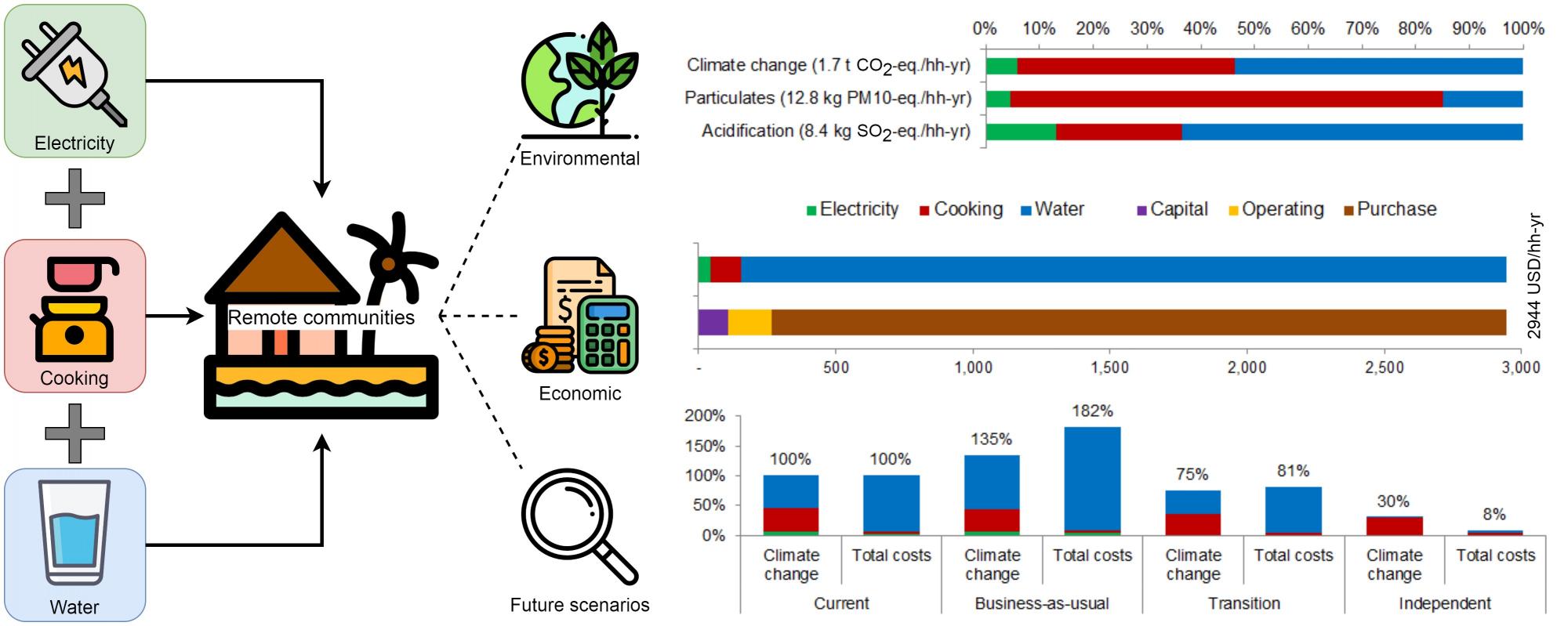
Improving access to energy and water in remote communities is an important step towards sustainable development. However, integrated sustainability studies at the community or household scale are rare compared to industrial or national studies. Thus, this paper presents an integrated approach to the development and evaluation of energy and water supply systems in remote communities in developing countries. Termed here “synergistic generation” (“synergen”), the approach considers simultaneously electricity, heat for cooking and water supply to determine their environmental and economic sustainability on a life cycle basis. Life cycle assessment and life cycle costing are used for this purpose. Both the current situation and future scenarios to 2030 are considered for a representative remote community. The life cycle costs of the current energy and water supply are estimated at 2944 USD/household per year, most of which (91%) is due to bottled water. The latter is also the main cause of current environmental impacts (62%), followed by cooking fuels (33%) and electricity (5%). If business as usual (BAU) continues to 2030, air pollution and eutrophication could be reduced by >40% but other 14 impacts would increase by 2–63% on the current situation due to higher dependence on diesel for electricity generation and bottled water. For the same reason, BAU also has 82% higher life cycle costs (5364 USD/household∙yr) than at present. Assuming full supply self-sufficiency (Independent scenario) leads to a >12% reduction in all impact categories, except terrestrial ecotoxicity, which increases by 5% – both trends are due to utilisation of waste biomass for cooking. The life cycle costs are reduced by 92% (231 USD/household∙yr), mainly due to the phasing out of bottled water. However, capital costs are 21% higher due to the need for multiple renewable energy installations. Pursuing moderate rather than full independence of supply (Transition scenario) would reduce most impacts and costs below those of the current situation. Overall, the Transition and Independent scenarios have lower impacts than at present in almost all environmental categories as well as lower life cycle costs. These findings demonstrate the environmental and economic feasibility of energy and water independence in remote communities as well as highlighting the likely trade-offs that should be considered during the transition.
Providing enough water in farming has become a challenge in the Philippines due to insufficient irrigation and escalating drought conditions, thereby decreasing agricultural productivity. The impact of this problem can be lessened through efficient water usage: by reducing water wastage in runoff or evaporation and improving soil water retention. Hydrogels can be used for this purpose due to their water absorption capabilities. In this study, a novel, biodegradable agricultural hydrogel was developed from κ-carrageenan, sodium alginate and carboxymethyl cellulose, crosslinked with Ca2+ and K+ ions. Scanning electron microscopy analysis confirmed the successful crosslinking while swelling tests revealed them as superabsorbent hydrogels, with maximum absorption reaching 2000%. Soil amended with 2% (w/w) hydrogel showed reduced water-depletion rate and improved field capacity by a maximum of 17.6% and 17.4%, respectively. Fertilizer release test also showed the potential of these hydrogels as fertilizer carriers.
Physically crosslinked superabsorbent hydrogels based on NaCMC, HPC, and NaAlg were developed to address the effects of water shortage to crop farming and to regulate fertilizer usage. An optimized synthesis was performed using ten different blends. The blend with a NaCMC/HPC/NaAlg ratio of 0.29/0.42/0.29 was found to exhibit the most favorable results, accommodating 1585% moisture and 8.38% fertilizer on a dry basis. Scanning electron microscope images of this blend manifested microporous structures, responsible for its superabsorbent properties. It was found out that applying the hydrogel at 5% loading to silt soil decreases fertilizer runoff by 28% and increases field capacity to 55%. Moreover, phytotoxicity studies showed that the optimum hydrogel blend exhibits no phytotoxic properties to pechay (Brassica rapa subsp. chinensis), lettuce eton (Lactuca sativa), and spinach (Spinacia oleracea), proving its applicability to agriculture.
Mark Louie L. Lugue. 2020. “UP Diliman North Sector.” In Adhika: Vision & Legacy – The University of the Philippines Diliman Collections. Quezon City: University of the Philippines Diliman Office for Initiatives in Culture and the Arts.
Plasma-activated zeolites were used in the removal of diclofenac sodium (DCF) via adsorption in an aqueous solution. The natural zeolites were exposed to 13.56 MHz radio frequency-driven plasma discharge using argon as the working gas. Results have shown an increase in adsorption capacity of DCF to 64% from 52% using the plasma-treated and untreated zeolites, respectively. Further analysis showed no significant changes in the bulk properties of the zeolite after plasma exposure. However, an apparent increase in surface porosity was observed after treatment due to etching and ablation effects of the impinging energetic particles from the discharge. The adsorption of DCF followed the Freundlich isotherm model suggesting that the modified surface is heterogeneous allowing multilayer adsorption. This work realized the enhancement of adsorption capacity of natural zeolites via plasma treatment. The plasma-treated zeolites are inexpensive candidates for the removal of emerging pharmaceutical wastes in wastewater such as DCF.
Copper (Cu) ions were successfully loaded in a bentonite matrix via ion-exchange method producing the Cu-Bentonite nanocomposites. Samples were treated using 13.56 MHz radio frequency (RF) plasma system with argon (Ar) and oxygen (O2) gases at varying input power (30 and 80 W) and constant treatment time of 10 min. X-ray diffraction patterns revealed the presence of Cu metal after the plasma treatment of samples. SEM images confirmed the changes onthe surface of the nanocomposites after plasma treatment. The untreated and treated Cu-bentonite nanocomposites showed effective antibacterial activity against E. coli and S. aureus. The nanocomposite can be used for biological as well as biomedical applications due to its antibacterial capabilities.